
Choosing the right wood burning stove for a standard British fireplace: measurements, flue and HETAS rules
Most homeowners searching for a wood burning stove hit the same wall early on: there are two fundamentally different technologies on the market, and the wrong choice produces a stove that either won’t fit the opening, won’t pass inspection, or costs significantly more to run than expected. British fireplaces add their own complications, awkward alcoves, old unlined flues, smoke control restrictions, and irregular Victorian openings all narrow the field before you’ve even chosen a model.
This guide is written from an engineering perspective. At Island Pellet Stoves, we specialise in designing stoves for standard UK fireplace openings, and we’ve worked through a wide range of awkward recesses and non-compliant flue situations across installations nationwide. That experience informs every section below.
By the end, you’ll know the required kW output for your room, whether your fireplace opening can accept a stove, what HETAS compliance actually demands, and what a compliant installation realistically costs in 2026.
Log burner or pellet stove: what “wood burning” actually covers today
A traditional log burner operates on a simple combustion principle: seasoned logs, a manual light, periodic reloading, and regular ash removal. The chimney needs sweeping at least twice a year, and you’ll need somewhere dry to store a meaningful volume of wood. The trade-off is authentic ambiance and a radiant heat that’s hard to replicate.
The downside is that even a well-run log burner produces meaningful particulate emissions. New appliances must meet the Ecodesign 2022 standard, which sets limits for particulate matter, carbon monoxide and organic gaseous compounds, alongside a minimum efficiency of 75%. Ecodesign compliance, however, does not automatically mean the stove is approved for use in a smoke control area. That’s a separate designation entirely, which we’ll cover shortly.
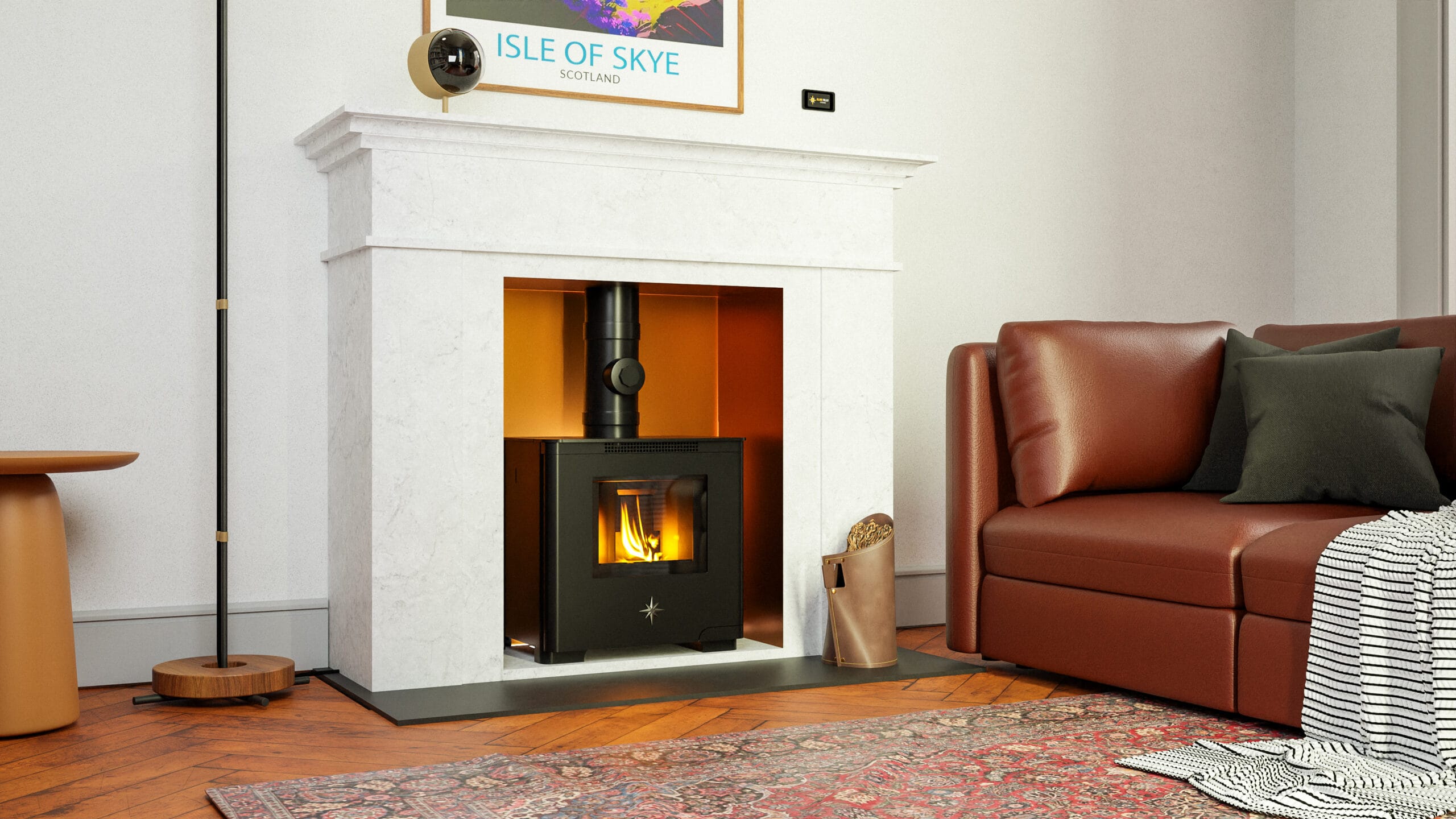
A modern pellet stove burns compressed wood pellets through an automated feed system. Ignition is electronic, fuel delivery is timer-controlled, and the sealed combustion chamber is designed to minimise smoke entering the room during operation. Emissions are substantially lower than those of a conventional log burner, pellet stoves of this type typically produce far fewer particulates, making them well-suited to smoke control areas where a DEFRA-exempt appliance is required. One misconception worth addressing directly is that cleaner combustion means a clinical, artificial-looking flame. It doesn’t. A well-engineered pellet stove produces a genuine, flickering flame that many users find closely mimics a traditional log burner.
On running costs, bulk wood pellets typically deliver useful heat at around 5.8 to 8.8p per kWh in 2026, based on current bulk market rates, making them competitive with smokeless coal and often cheaper than purchased seasoned logs, which can reach 8 to 15p per kWh depending on source and moisture content. Maintenance on a pellet stove centres on regular burn-pot cleaning and an annual technical service. A log burner requires chimney sweeping twice a year, ash disposal, and consistent access to properly seasoned fuel. For homeowners who want lower ongoing effort alongside lower emissions, pellet stoves deserve serious consideration alongside conventional log stoves.
How to size a wood burning stove correctly for your room
The standard sizing method uses room volume divided by an insulation factor to estimate the required kW output. Measure your room in metres (length × width × height), then divide by the appropriate figure from the table below.
| Room condition | Divide volume by | Typical features |
| Poorly insulated | 10 | Solid walls, single glazing, draughts |
| Average insulation | 14 | Cavity walls, double glazing, loft insulation |
| Well insulated | 24 | Modern airtight build, high-performance glazing |
As a worked example: a 5 m × 4 m × 2.4 m room in an average Victorian terrace gives a volume of 48 m³. Divided by 14, that yields roughly 3.4 kW. This is a starting estimate, not a precise specification, and it assumes a target indoor temperature of around 21°C against a near-zero outdoor temperature.
There are genuine reasons to adjust upward: multiple external walls, large areas of single glazing, open-plan connections to adjoining rooms, high ceilings, or a wood burning stove expected to contribute to whole-house heating. Resist the temptation to oversize significantly. A stove run at chronically low output to avoid overheating the room is run inefficiently, and according to industry guidance this may produce more deposits in the flue and place additional strain on the appliance over time. For anything beyond a single standard room, a room-by-room heat-loss calculation by a qualified heating engineer is more reliable than the volume formula alone.
Measuring your fireplace opening for a wood burning stove
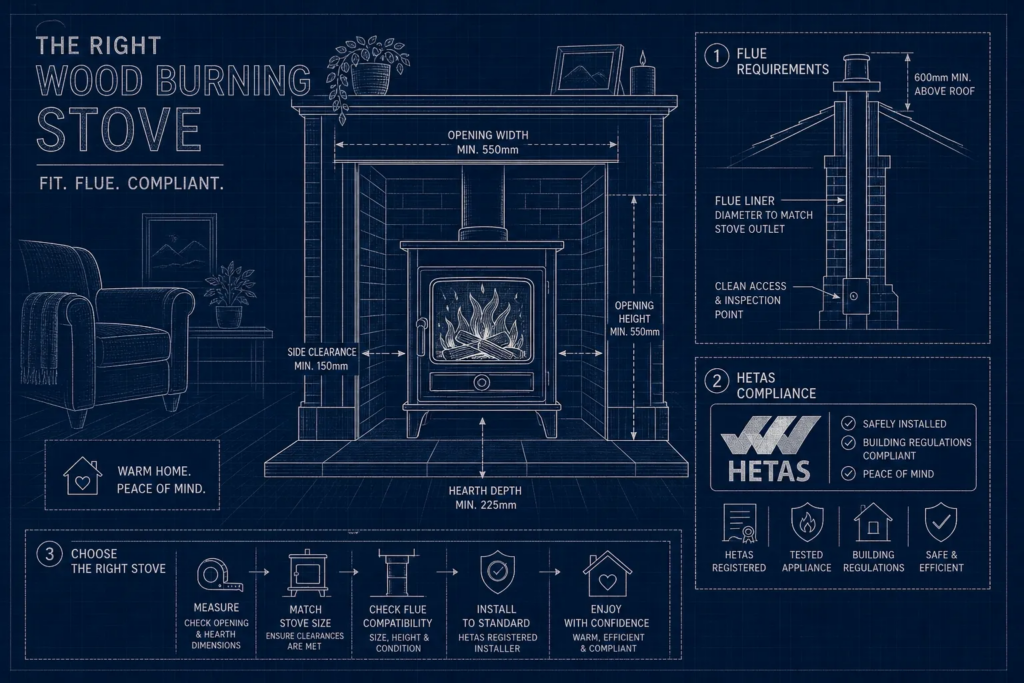
Three dimensions determine whether a stove body will fit: internal width, internal height, and depth of the fireplace recess. British fireplace openings vary considerably by era and property type. A Victorian cast-iron insert opening can be as narrow as 405 mm wide; larger Edwardian openings may reach 865 mm or more across, with depths typically ranging from 250 to 510 mm. As a rough starting point, many mid-terrace Victorian properties have openings in the region of 400 to 500 mm wide and 450 to 560 mm high, but always measure at the narrowest point, because old openings are frequently tapered or irregular.
The stove body must sit within those dimensions with adequate clearance to any combustible surround material. Under Approved Document J, combustible material beside the fireplace recess must be at least 200 mm from the inside surface of the recess. A combustible mantel or surround around the fire opening requires at least 300 mm clearance above the opening and 150 mm horizontally to either side. The hearth must project at least 225 mm in front of a closed appliance. These are minimums: always follow the stove manufacturer’s stated clearances where they are larger.
Flue exit position matters as much as body dimensions. A rear-exit flue connection requires a curved connector that consumes recess depth you may not have. A top-exit design routes the flue vertically up the chimney breast without eating into the available depth. This is precisely why Island Pellet Stoves designed our compact stove with a top-mounted flue, so that it can slide into a standard UK recess without requiring modification to the surround or the opening.
Flue requirements for a wood burning stove and what HETAS compliance actually means
For a traditional log-burning stove, the flue liner is typically 150 mm in diameter. A 125 mm liner may be acceptable only where a specific appliance is approved for that size and the manufacturer explicitly permits it. Old masonry chimneys must be lined with a continuous flexible steel liner rated for solid fuel: an unlined or incorrectly sized flue is the most common reason stove installations fail inspection. The liner specification must carry the appropriate designation under BS EN 1856, and the installation must comply with Building Regulations Approved Document J, the governing document for combustion appliances in England and Wales.
Pellet stoves use a different flue specification. Because they’re fan-assisted appliances operating under positive pressure, they typically require a pressure-rated, gasketed flue system designated P1, rather than a standard natural-draught flexible liner. The flue diameter is also smaller: commonly 80 to 100 mm, depending on the appliance. Do not apply log-stove flue rules to a pellet installation; the two systems are not interchangeable.
A HETAS-registered installer can self-certify the installation to Building Regulations without the homeowner separately notifying the local authority, this is set out in HETAS guidance and the relevant provisions of Approved Document J. The installer issues a compliance certificate, which you retain for insurance purposes and future property sale. Without a registered installer, the homeowner must submit the work to local-authority Building Control before starting, with associated fees and timeline delays.
A carbon-monoxide alarm meeting BS EN 50291 is a Building Regulations requirement for any new solid-fuel appliance installation, and it must be fitted as part of the job. This applies to every wood burning stove installation, regardless of technology type.
On smoke control areas: an Ecodesign-compliant stove is not automatically DEFRA-exempt. In a smoke control area, the specific appliance model must appear on the official DEFRA Clean Air Act database, approved for burning the intended fuel type. Check the database by manufacturer and exact model number, not just the product range. Confirm whether your property sits within a smoke control area via your local authority; the national map is indicative, and the council is the definitive check.
What a compliant installation realistically costs
A wood burning stove supplied in the UK typically costs between £500 and £2,500, with well-specified mid-range models sitting around £800 to £1,400. Premium or high-output stoves exceed £3,000. The stove itself is only part of the budget. Installation into an existing chimney with a new flexible liner runs from roughly £2,200 to £4,500 all-in for a typical property. Where no chimney exists, a twin-wall flue system adds £2,500 to £6,000 or more before any structural work.
The main line items in an installation bill break down as follows:
- HETAS-registered labour: £500 to £1,500
- Flexible chimney liner, supplied and fitted: £400 to £1,800 depending on chimney height
- Hearth alterations: £200 to £1,200
- Chimney repairs or scaffolding: £300 to £1,500 or more
A reasonable average budget for a mid-range stove installed into an existing chimney is £2,500 to £3,500 all-in. Prices rise sharply for difficult roof access, tall chimney stacks, listed buildings, or installations in smoke control areas requiring a DEFRA-exempt appliance. Sourcing the stove, flue components, installation, and certification from a single provider is a practical way to reduce the risk of compatibility issues and unexpected costs, a common source of budget overruns is a stove purchased from a retailer that turns out to be incompatible with the flue or recess once the installer arrives.
Why a compact pellet stove belongs on your shortlist
For homeowners in Smoke Control Areas, a pellet stove that appears on the DEFRA Clean Air Act Exempt list simplifies compliance considerably, using a HETAS-registered installer then handles the Building Regulations notification side without any separate action from the homeowner. For those who want the look and warmth of a traditional fire without the weekly effort of log management, a pellet stove with a realistic dancing flame delivers both. Automated ignition, timer-controlled fuel feeding, and sealed combustion mean you set the schedule and the stove does the rest.
Island Pellet Stoves addresses the British fireplace problem directly. Our stoves are built in Cardiff to fit standard UK recess dimensions, with a top-mounted flue designed to avoid modification to the surround. The convection-based heat distribution system uses a finned-tube heat exchanger rather than a fan, which eliminates operational noise, something many homeowners notice immediately when comparing with fan-driven alternatives. The combustion system produces a genuine, flickering flame. Every installation is carried out by HETAS-registered engineers, with a compliance certificate issued as standard. Substantially lower particulate emissions than a conventional log burner mean the stoves are suitable for smoke control areas where a DEFRA-exempt appliance is required.
All-in packages start from £4,950 and cover the stove, flue pipes, HETAS-certified installation, and a personal training session so you understand exactly how to operate and maintain the appliance from day one. This starting price reflects a straightforward installation; our team will confirm any variation for more complex works during your assessment. Nationwide installation is available. Book a free fireplace assessment with our team, we’ll confirm whether your opening suits our stove and which output is appropriate for your home, whether that’s our 3 kW compact model or our 8 kW whole-house version.
The decision in plain terms
A wood burning stove is a meaningful investment in both comfort and compliance, and getting the sizing, flue specification, and installer right matters far more than the stove’s aesthetic alone. The process is straightforward when approached in order: measure the recess accurately, calculate the required kW output using the volume method, confirm whether your property is in a smoke control area, and engage a HETAS-registered installer who can self-certify the work.
For homeowners who want lower maintenance, lower emissions, and a simpler installation path, a modern pellet stove built for British fireplace dimensions is a practical and increasingly popular alternative to a traditional log burner. Wood-burning stoves in the UK have come a long way in terms of technology, and today’s pellet options no longer require any sacrifice of the real-fire experience in exchange for the convenience of automated heating.
If you’re ready to take the next step, contact Island Pellet Stoves to book a free, no-obligation fireplace assessment. We’ll confirm the right output for your home and handle everything from manufacture through to HETAS certification.