
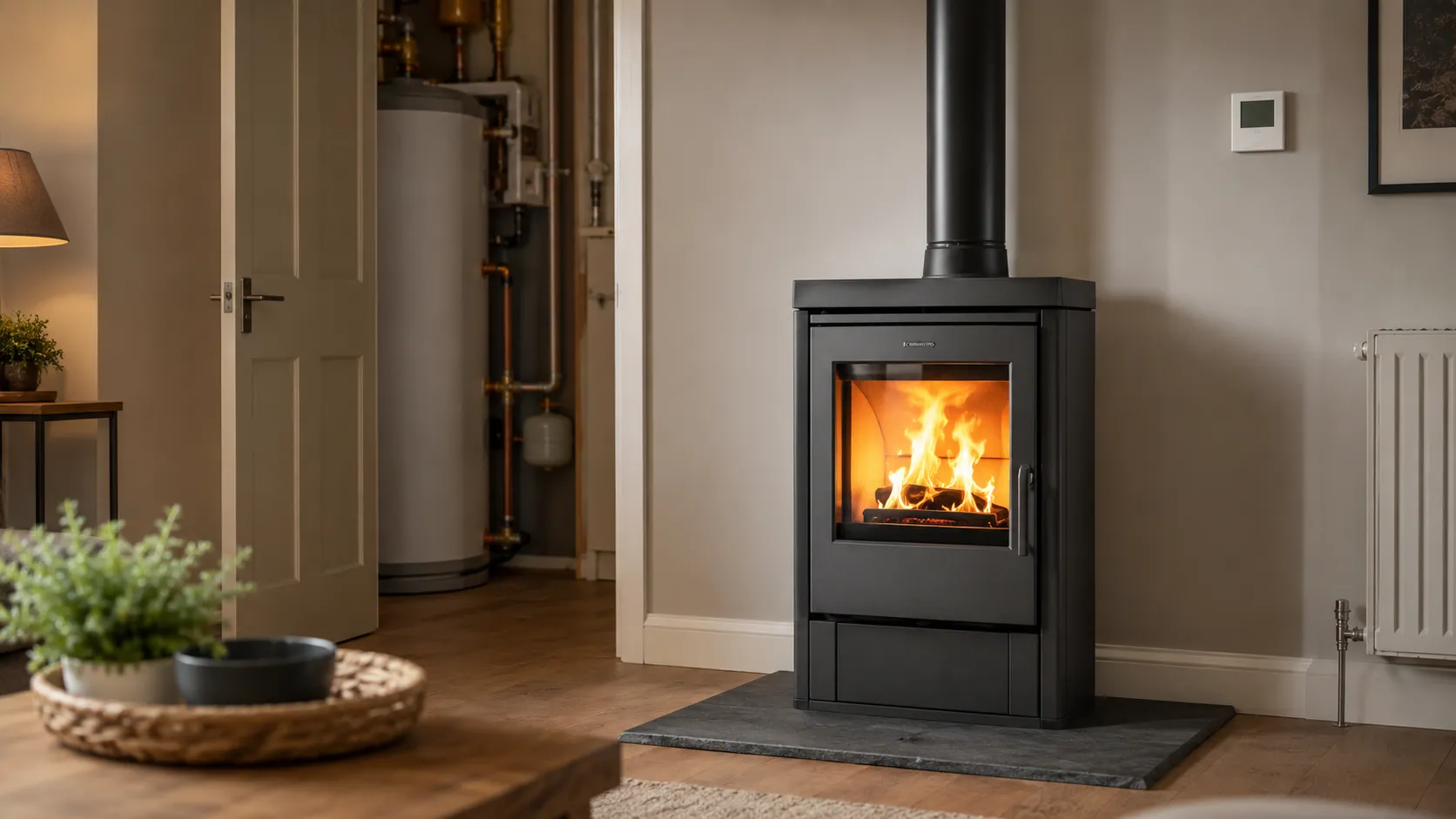
How Does a Wood Burner With Back Boiler Work With Modern Heating Controls?
If you are asking how a wood burner with a back boiler works, the simple answer is that the stove heats the room while a boiler section transfers some of the fire’s heat into water.
In a modern home, that is only half the story. The real difference comes from what happens next: how that hot water is moved, stored, controlled and used safely.
This is where the controls earn their keep. Pumps, thermostats, valves, cylinders and thermal stores all help decide whether the heat goes to radiators, hot water storage or another part of the system. Without that planning, even a good stove can feel awkward to live with.
At Island Pellet Stoves, we like the appeal of a real flame, but we also believe the practical side has to be right. A back boiler stove should work sensibly as part of the wider heating system.
The simple answer: fire heats water
A wood burner with a back boiler works by transferring some of the fire’s heat into water.
The stove still warms the room directly. The difference is that a boiler section, sometimes called a water jacket or heat exchanger, captures part of the heat and passes it into a water circuit.
The detail worth remembering is that a back boiler stove is not the same as a gas combi boiler. It does not instantly start and stop heat production at the flick of a thermostat. It is tied to the burn cycle of the fuel, so the rest of the system needs to be ready to use or store that heat.
How the heat moves through the system
It helps to picture the setup as a route the heat has to travel.
| Part of the setup | What it does |
| Stove firebox | Burns fuel and produces room heat |
| Back boiler section | Transfers part of the heat into water |
| Pipework | Carries heated water away from the stove |
| Pump or circulation route | Moves water through the system |
| Controls | Help manage timing, temperature and flow |
| Cylinder or thermal store | Stores useful heat for hot water or later use |
| Radiators | Release heat into other rooms, where suitable |
A good setup gives the heat a clear path. A poor setup leaves the heat with nowhere sensible to go, which can make the system harder to control.
What modern heating controls actually do
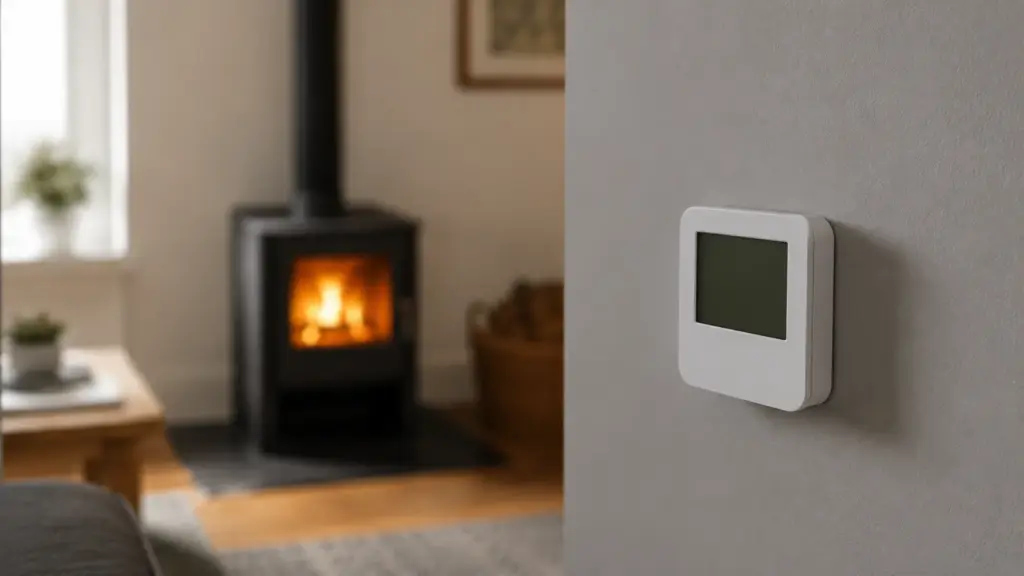
Heating controls are not there to make the system feel complicated. They are there to make it behave.
The Energy Saving Trust’s guide to heating controls explains that heating controls cover components that tell heating when to come on and off and help set the temperature of the home.
In a back boiler setup, the controls may include:
- Pipe thermostats
- Room thermostats
- Pump controls
- Motorised valves
- Cylinder thermostats
- Overheat protection
- Controls for another heat source, if the home has one
Their job is to help move heat where it is needed and avoid sending it where it is not. For example, a pump may only start moving water once the stove circuit reaches a suitable temperature. A cylinder thermostat may stop calling for heat when the stored water is hot enough.
Good controls do not take away the charm of the stove. You still get the flame, the warmth and the focal point. The controls help make the water side of the system more predictable and easier to manage.
Why a thermal store can matter
A thermal store is a way of holding heat in water so it can be used more steadily.
That can be useful because a stove produces heat while it is burning. A thermal store can help capture heat during the burn and make it available for hot water or space heating later, depending on how the system is designed.
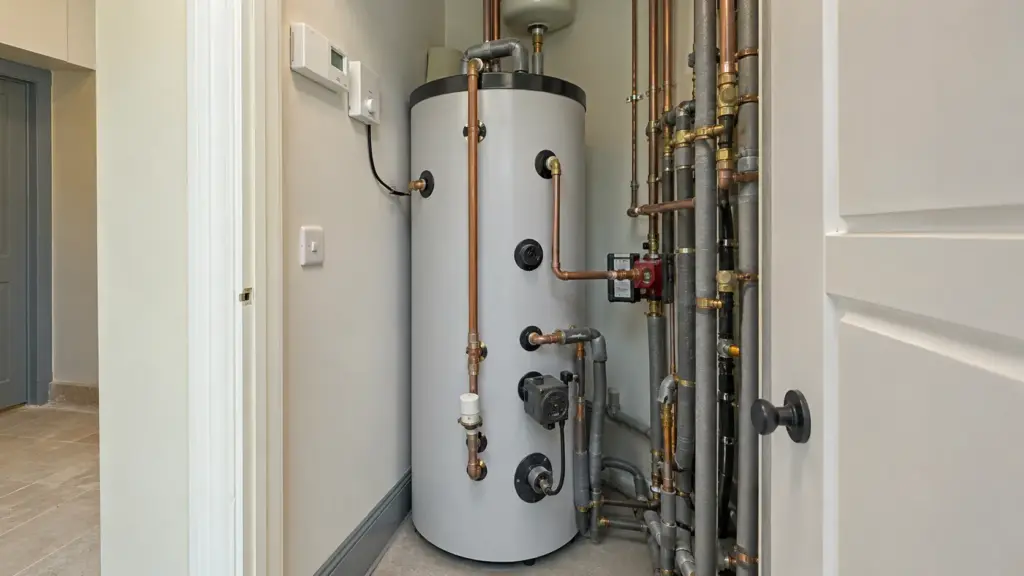
Forest Research’s guide to small-scale biomass heating explains that log boilers are batch-fed and require a large water storage cylinder, such as a thermal store, accumulator or buffer tank, to capture the heat produced.
Our guide to pairing a back boiler with your heating system goes deeper into how the stove, radiators, hot water and storage side can work together.
Can it work with radiators and hot water?
Yes, a wood burner with a back boiler can be designed to support radiators and hot water. But the word “designed” is doing the heavy lifting there.
Whether it works well comes down to a few practical checks:
- The stove’s heat output to the room
- The stove’s heat output to water
- The heat demand of the home
- The radiator circuit
- The hot water cylinder or thermal store arrangement
- The flue and ventilation setup
- How often the stove will actually be used
A back boiler stove may support a wider heating system, but it should not be assumed to replace every other heat source in every home.
A smaller stove cannot heat a large, heat-hungry property just because it has a boiler section.
Flue, ventilation and safety still come first
A back boiler stove is still a combustion appliance, so the installation has to deal properly with air supply, flue gases, hearths and building protection.
GOV.UK’s guidance on combustion appliances and fuel storage systems covers areas such as air supply, discharge of combustion products, fireplaces, flues, chimneys and protection of the building.
Put plainly, the flue is not just a pipe. It is part of the safety system.
For a more stove-focused overview, our article on wood-burning stove regulations explains why Part J, carbon monoxide safety and competent installation matter.
Can you add a back boiler to an existing wood burner?
Not always.
Some stoves are designed from the start as boiler stoves. Others are designed only as room heaters. Trying to turn the wrong appliance into a back boiler setup can create safety, performance and warranty problems.
Before thinking about adding a back boiler, check:
- Whether the stove is suitable for boiler use
- Whether the manufacturer allows it
- Whether the flue route is suitable
- Whether the heating system can accept the heat
- Whether storage or cylinder changes are needed
- Whether controls and safety devices can be fitted properly
Our guide on whether you can fit a back boiler to a wood burner covers this question in more detail.
This is one of those jobs where “it should be fine” is not a design method. A proper assessment is far better than trying to rescue a poor fit later.
Where pellet boiler-stoves fit in
A traditional log stove with a back boiler and a pellet boiler-stove are related ideas, but they do not behave in the same way.
A log stove is more hands-on. You load the fuel manually, and the heat follows the burn pattern of the logs. A pellet appliance can offer more controlled fuel feed and combustion, depending on the model.
That is why our Lundy 8 pellet boiler-stove may be worth reviewing if you are exploring stove-based water heating. It sits in the boiler-stove category rather than being only a room-heating stove.
It still needs to suit the property, flue route, water storage and heating design. The Lundy 8 is a relevant model to review when discussing this type of appliance with our team.
Common control and design mistakes to avoid
A back boiler stove can work well when the whole system is thought through. Most problems start when one part is chosen in isolation.
Common mistakes include:
- Choosing the stove before calculating heat demand
- Ignoring the split between room heat and water heat
- Assuming an existing fireplace or flue will be suitable
- Leaving no practical route for stored or excess heat
- Treating controls as an optional extra
- Expecting the stove to behave like a combi boiler
- Forgetting about cleaning, servicing and fuel storage
Old-fashioned measuring twice and cutting once still applies here. It is much easier to design the system properly at the start than to correct an awkward setup after installation.
Is this type of setup right for your home?
A wood burner with a back boiler may suit you if you want visible flame, useful room heat and the potential to support radiators or hot water.
It may be less suitable if you want a fully automatic system that you rarely think about. Stove-based heating usually requires more involvement, from fuel and cleaning through to servicing and daily use.
During an initial discussion, the useful questions are usually practical ones: where the stove could sit, how the flue would run, whether there is space for a cylinder or thermal store, how much heat the home needs, and how often the stove would realistically be used. Those details tell us far more than simply asking whether a back boiler stove is “powerful enough”.
Before deciding, ask:
- How much heat does the home need?
- Is there a suitable flue route?
- Is there space for a cylinder or thermal store?
- Are the radiators suitable?
- How will excess heat be managed?
- How much daily involvement do you want?
- Who will design and install the complete system?
Those questions are there to prevent the wrong stove from being forced into the wrong home.
The practical takeaway
A wood burner with a back boiler works by using the fire to heat the room and transfer part of that heat into water. Modern heating controls then help move, store and manage that heat so it can be used sensibly.
In a modern home, the stove is only one part of the setup. The flue, thermal storage, pumps, thermostats, valves, safety devices and heat demand all matter.
At Island Pellet Stoves, our view is straightforward. Start with the home, then choose the appliance. If the heat demand, flue route, controls and storage all make sense, a back boiler stove may offer real flame, useful room heat and support for a wider heating setup where the home and system design suit it.
If you are considering this type of setup, contact Island Pellet Stoves to talk through your home, heating plans and the practical options available.