
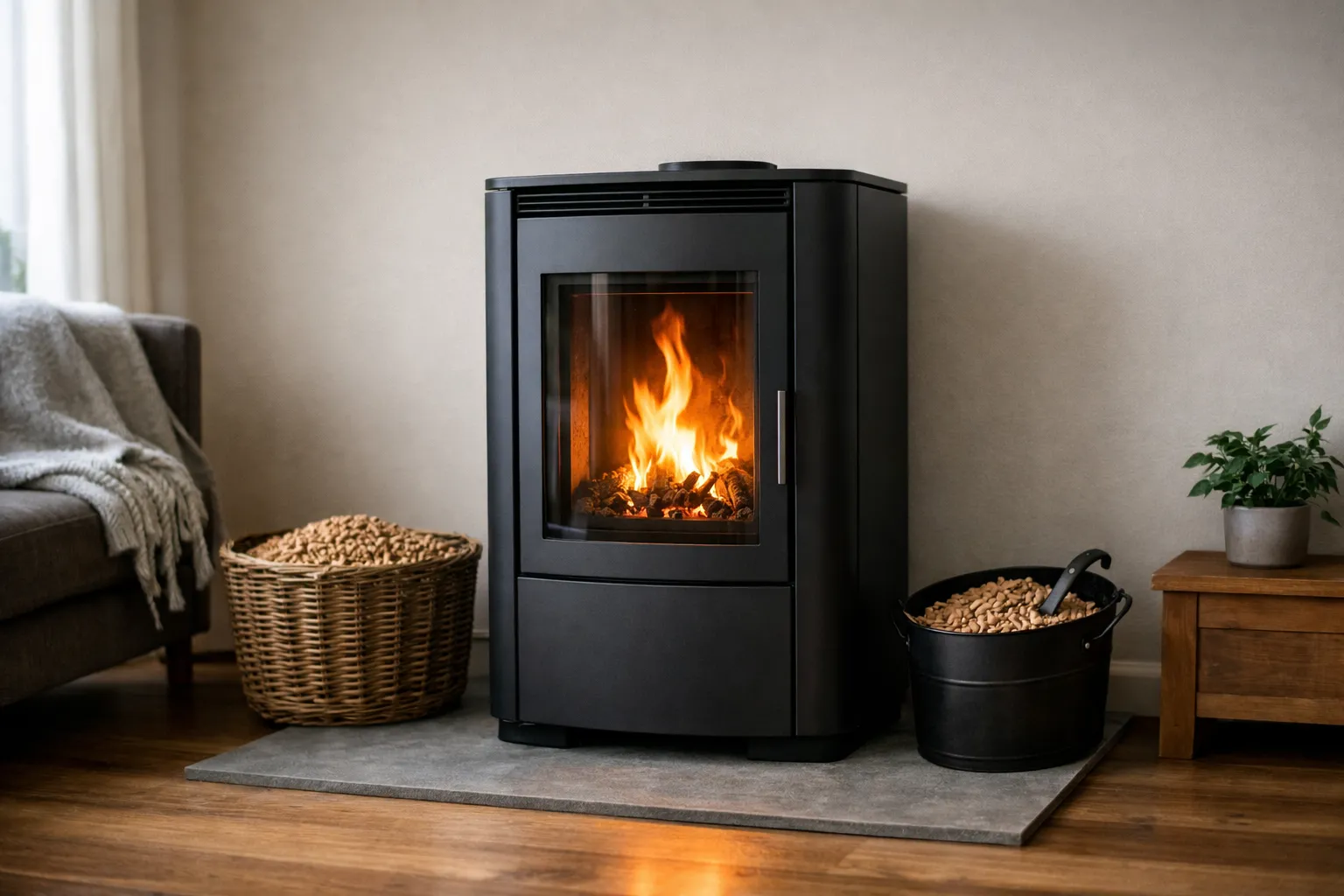
How Much Does It Cost to Run a Pellet Stove?
When we ask “how much does it cost to run a pellet stove?”, we are really asking a simpler question: how much do we pay for each unit of heat we actually get into the home. Once we focus on delivered heat rather than bags, pallets, or vague averages, the estimate becomes far more reliable.
For most households, the running cost comes down to three parts:
- Pellets (the main cost)
- Electricity (a smaller add-on)
- Servicing and routine upkeep (what keeps performance stable)
This guide shows how to calculate a sensible estimate, and how to sanity-check it using your own usage once the stove is in routine.
What “running cost” really includes
People often use “running cost” as shorthand for pellet spend. Pellets are the headline, but if we want a true picture, we include the other costs that keep the stove working as designed.
The three cost buckets worth budgeting for
Pellets (fuel)
Pellets drive most of the cost. The amount you use depends on run time, heat output, and how much heat the building loses.
If you want a practical overview of pellet sourcing and what to look for when comparing options, our guide to pellet stove fuels and supply options is a useful reference.
Electricity
Pellet stoves use electricity for ignition, the feed system, control board, and fans. It is usually modest compared with fuel, but it belongs in the total.
Servicing and maintenance
A pellet stove is not a decorative heater. It is a combustion appliance with moving parts and controlled airflow. Routine cleaning and proper servicing help keep efficiency steady, reduce nuisance faults, and support safe operation.
Pellets: what you pay per kWh of delivered heat
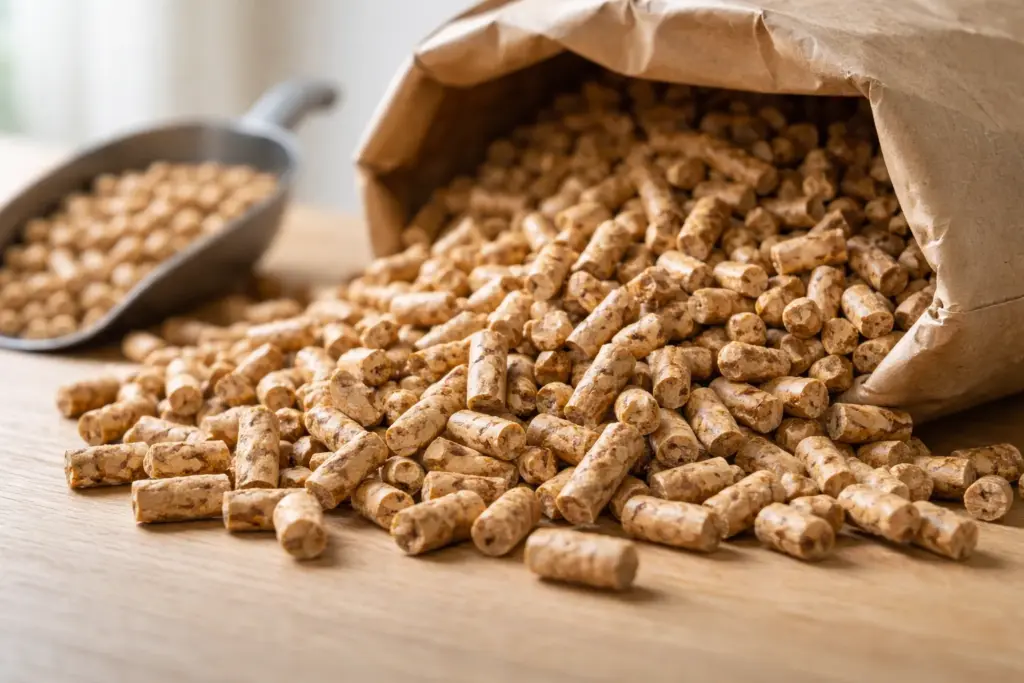
The most useful way to price pellet heating is to convert pellets into pence per kWh of delivered heat. That lets us compare costs consistently, even when pellets are sold in different quantities.
A UK benchmark for pellet energy content
A commonly used UK reference for typical wood pellet energy content is published by Forest Research. Their table of typical calorific values of fuels supports a practical budgeting benchmark of around 4.8 kWh per kilogram, depending on moisture content and fuel specification.
Using that as a baseline:
- 1 kg of pellets contains roughly 4.8 kWh of fuel energy
- 1 tonne (1,000 kg) contains roughly 4,800 kWh of fuel energy
Efficiency: why does the same tonne not deliver the same heat in every home
A stove does not turn all fuel energy into room heat. Some heat exits through the flue, and day-to-day performance depends on installation, airflow, settings, and how clean the appliance is.
For budgeting, we often use an assumed operating efficiency range. Many modern pellet stoves are designed to run at high efficiencies, but rather than pretending every home hits a perfect figure, a planning range of 85% to 90% keeps estimates realistic.
That means one ton might deliver approximately:
- 4,800 kWh × 0.85 = 4,080 kWh delivered heat
- 4,800 kWh × 0.90 = 4,320 kWh delivered heat
If you want a more exact figure for your model, your stove manual or manufacturer documentation is the best source. Swap that number into the calculation, and your estimate tightens immediately.
A reusable cost-per-kWh table
Use this formula:
Pellet cost per kWh (delivered) = Pellet price per tonne ÷ Delivered kWh per tonne
Here is a quick table you can reuse by replacing the pellet price with the figure you actually pay.
| Example pellet price per tonne | Delivered kWh per tonne (85% to 90%) | Estimated cost per kWh delivered |
| £250 | 4,080 to 4,320 | 5.8p to 6.1p |
| £350 | 4,080 to 4,320 | 8.1p to 8.6p |
| £450 | 4,080 to 4,320 | 10.4p to 11.0p |
These are examples to show the method, not a claim about what pellets “should” cost. Your real number comes from your delivered price and the way you run the stove.
Pellet quality and consistency: why it matters to cost
Pellet quality is not just about how tidy the ash pan looks. Consistent fuel supports consistent combustion, which helps the stove hold its output without constant adjustment and reduces deposits that steal heat transfer over time.
If you want a regulator-led reference point for expected pellet standards, Ofgem’s guidance mentions ENplus A1 or equivalent requirements for wood pellets in its woodfuel requirements guidance.
Electricity: the quiet add-on
Electricity usage varies by model and operating mode, especially during ignition. The easiest way to estimate electricity cost is to calculate how many kWh the stove uses while it is on, then multiply that by your unit rate.
A practical approach is:
- Use your manual to find the typical power draw, or use a cautious average for budgeting.
- Multiply by hours used to get kWh.
- Multiply by your electricity tariff.
To anchor your unit-rate assumption, Ofgem publishes the current cap information and general guidance on the energy price cap. Your own tariff may be different, but the cap is a clear reference point.
As a quick illustration, if a stove averages 0.15 kW while running and you use it for 6 hours, that is 0.9 kWh of electricity. Multiply 0.9 kWh by your unit rate to get a sensible daily electricity allowance.
Servicing and upkeep: what keeps running costs from drifting upward
A pellet stove can stay consistent for years, but only if we keep it in good order. When performance drops, it is often not “mysterious pellet prices”; it is basic physics: blocked pathways, deposits on heat-exchange surfaces, worn seals, or airflow issues.
Routine care protects:
- Efficiency (better heat transfer, steadier output)
- Reliability (fewer nuisance faults and stoppages)
- Safe operation (proper combustion and correct ventilation)
Flue and airflow details matter here. If you are planning an installation or reviewing an existing setup, our guide to pellet stove chimney and flue requirements explains what influences combustion quality and everyday performance.
A worked example you can adapt to your routine
Let’s use a simple example that you can adjust.
Say we run the stove at an average of 3 kW heat output for 5 hours per day:
- 3 kW × 5 hours = 15 kWh delivered heat per day
If your pellet cost works out at 8.5p per kWh delivered, your daily pellet spend is:
- 15 kWh × £0.085 = £1.28 per day
Now add your electricity allowance using your unit rate and typical running hours. Finally, include servicing as an annual line item, because the most accurate “running cost” includes what keeps the stove operating efficiently over time.
How we sanity-check the estimate without guessing
If you want to turn the estimate into something you trust, a short tracking check helps:
- Record total pellet usage over 7 days at normal settings.
- Note how many hours the stove ran in the same period.
- Compare your actual pellet use to your estimate.
This tells you whether your assumed efficiency and heat-output expectations are in the right range for your home. It also gives you a weekly cost figure grounded in your real routine, which is the only “average” that matters.
Choosing a stove that matches how we heat the home
Running-cost calculations only hold up if the stove choice behind them makes sense. A stove that is too large may be run in a way that is less efficient for your routine. A stove that is too small may be pushed harder than it should be. In both cases, costs can creep up because the match is off.
If you are comparing options, have a look through our wood pellet stoves range and pick out one or two models that match how you actually heat your home. If you want a quick sense-check before you decide, get in touch, and we’ll talk you through the options.
In summary
Pellet stove running costs are usually predictable when we price them properly:
- Convert pellets into pence per kWh of delivered heat using a reputable energy-content reference.
- Add a realistic electricity allowance based on your running hours and tariff.
- Budget for servicing and routine care, because efficiency does not maintain itself.
If you only remember one thing: price pellets by delivered kWh first, then layer in electricity and maintenance. That is how we get a number that stands up in real life, not just on paper.