
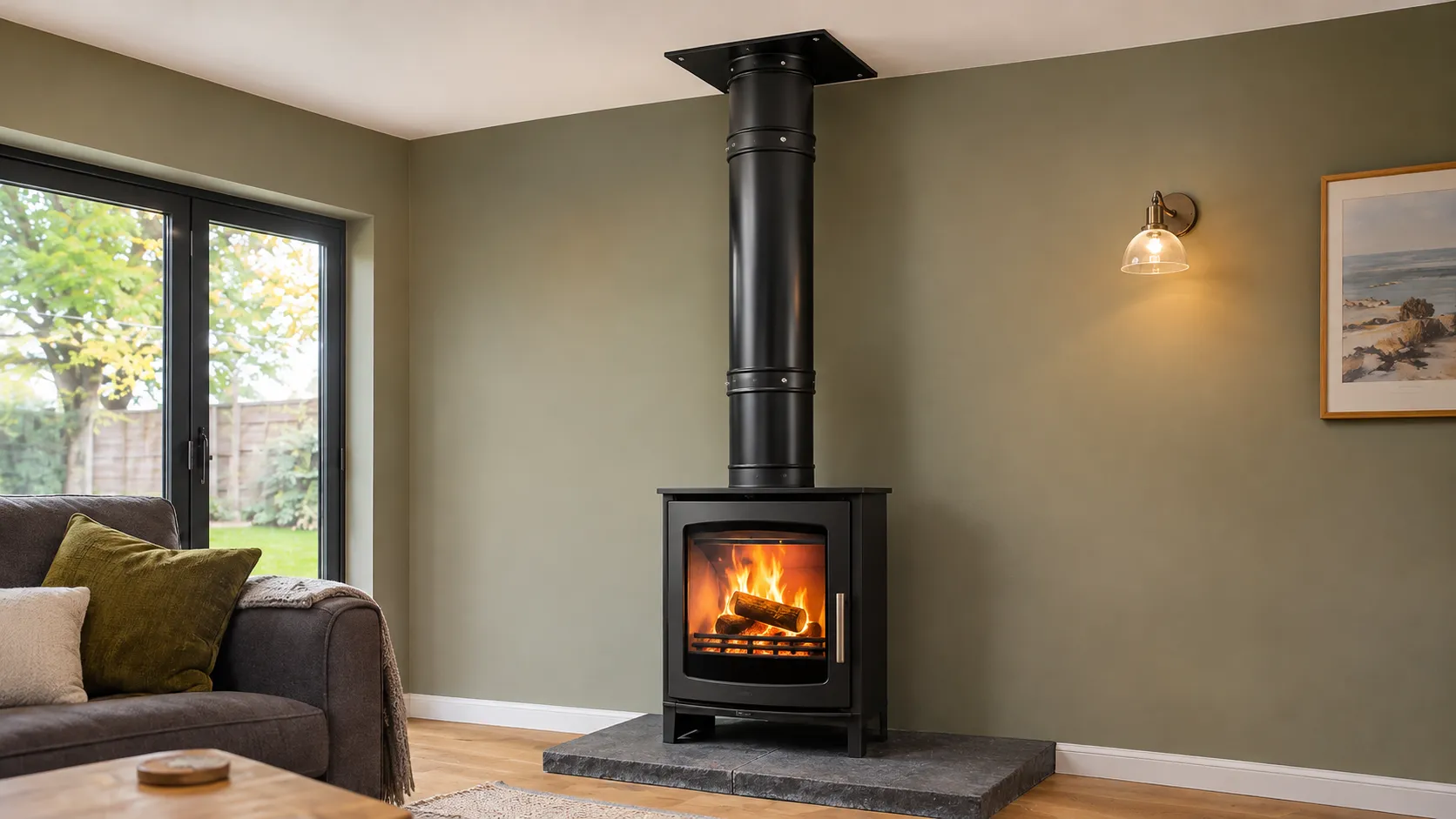
Can you have a log burner without a chimney? Your options explained
Yes, you can have a log burner without a chimney. Most homes without one can take a twin wall flue, an insulated steel pipe that does the job of a chimney and runs inside or outside the house. If that route does not suit your home, a pellet stove on a balanced flue can leave through an external wall instead.
This guide compares both routes and the flue-free alternatives across the UK, with typical costs and the rules for each nation.
Key takeaways
- A log burner needs a flue but not a brick chimney. A twin wall flue is the usual solution, and in most homes it can rise an external wall or through the house.
- A balanced flue is a sealed, double-walled pipe that can leave straight through a side wall, but it only works with a stove designed for it, such as our pellet stoves.
- The cost of fitting a log burner with a new flue depends mainly on the stove and the flue route. Our balanced flue packages start from guide prices of £4,950.
- Every new or replacement stove needs a carbon monoxide alarm, and building rules differ between England, Wales, Scotland and Northern Ireland.
Do you need a chimney for a log burner?
You do not need a traditional chimney for a log burner, but you do need a flue to carry smoke and gases safely out of the house. HETAS, the UK body for solid fuel and biomass, says that in most properties without a chimney “a system chimney may be installed”, running inside or outside the property where it is safe to do so.
You can have a wood burner without a chimney on the same terms, because log burner and wood burner mean the same appliance. The deciding factor is a safe flue route from your chosen spot to the open air.
Your options if you have no chimney
Homeowners without a chimney have four main options, which differ in cost, fire type and building work.
| Option | Typical cost (inc. VAT) | Flue | Fuel | Real flame |
|---|---|---|---|---|
| Log burner with twin wall flue | Depends on the stove and flue route | Twin wall, usually above the roof | Logs | Yes |
| Pellet stove with balanced flue | £4,950 to £6,540 capped guide price, fitted | Through a wall or roof | Wood pellets | Yes |
| Gas stove | Around £1,500 to fit plus £750 for the stove, from our cost guide | Depends on model | Gas | Yes |
| Electric stove | Around £1,750 average, from our cost guide | None | Electricity | No |
Bioethanol fires also need no flue, but they suit smaller spaces or secondary heat rather than a main heat source.
What is a twin wall flue?
A twin wall flue is a factory-made metal chimney with insulation between an inner and outer steel skin. The insulation keeps the flue gases hot, which helps them rise and draw the fire.
You have two routes. An external flue leaves through the wall and climbs the outside of the house, while an internal flue rises through ceilings and out of the roof. Internal routes need boxing in where they pass through upstairs rooms, and external routes are visible from outside.
Approved Document J, the guidance for England, sets out what a conventional solid fuel flue should achieve:
- Height: a minimum flue height of 4.5m “could be satisfactory” if the outlet guidance is followed (paragraph 2.8).
- Outlet: the flue outlet should be above the roof of the building (paragraph 2.10).
- Ridge clearance: a flue at or within 600mm of the ridge should finish at least 600mm above it (Diagram 17).
A log burner also needs a suitable hearth, and a constructional hearth should be solid, non-combustible and at least 125mm thick (paragraph 2.24). We cover flue heights further in our guide to flue and chimney regulations.
What is a balanced flue stove?
A balanced flue stove is a sealed stove that takes all its combustion air from outside through a double-walled pipe. Approved Document J defines a balanced flue appliance as a type of room-sealed appliance, meaning its combustion system is sealed from the room. The inner pipe carries flue gases out, and the outer pipe brings fresh air in.
Our pellet stoves work a lot like a modern gas boiler, which brings three practical differences for a home with no chimney:
- Shorter route: the flue can be much shorter than a standard chimney and can go straight out through a side wall.
- No extra vents: the pipe is airtight, so you do not need to cut vents into your walls for combustion air, which suits well-insulated homes.
- Wind resistance: the design stops smoke blowing back into the room on windy days.
A balanced flue is not an add-on for an ordinary log burner, because the stove itself must be designed to run sealed.
The flue outlet diagrams in Approved Document J describe a flue above the roof, so a flue that ends on a wall or below the roofline needs its own evidence. We include a professional report with our balanced flue installations that you can give to your local building inspectors. The installation is then signed off either by a HETAS registered installer, who self-certifies the work and issues a HETAS certificate, or through building control. The Building Regulations section below covers what applies in each nation.
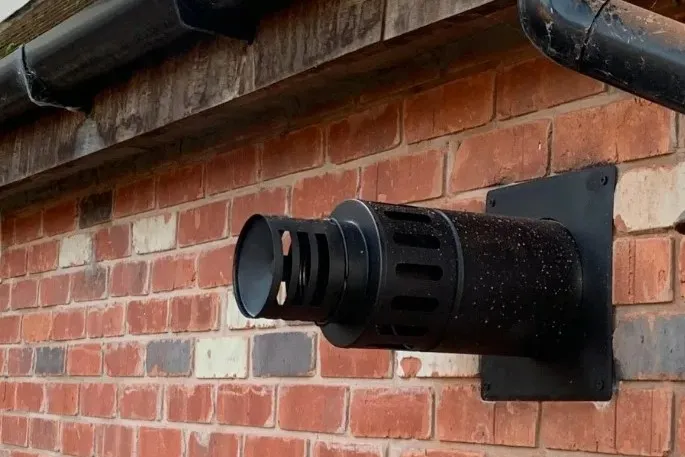
Two of our stoves show this in practice:
| Stove | Output | Concentric flue | Hopper | Guide price, fitted |
|---|---|---|---|---|
| Ramsey | 6kW | 100/150mm | 12kg | £6,250 inc. VAT |
| Lundy 5 | 4.9kW rated | 4-inch twin wall | 15kg | £6,540 inc. VAT |
Both are rated at 82% efficiency and approved by Defra for use in smoke-controlled areas. The Ramsey has a top flue connection and is designed for freestanding spots with no chimney. The Lundy 5 can run on a conventional flue or a balanced one.
How much does it cost to install a stove without a chimney?
The cost of installing a log burner without a chimney depends on the stove and the flue system it needs, and our wood burner cost guide sets out typical figures. The height of the flue, whether it runs inside or outside the house, and any boxing in all affect the total, so your own quote will depend on the flue route.
Our balanced flue packages include the stove, flue, installation and a HETAS certificate at a capped guide price, and most customers pay less than that figure. The final price depends mainly on flue design, so we ask for photos of your home to confirm the design before offering a price.
Example: you live in a bungalow with no chimney, in a smoke control area, and want heat in a rear living room. A log burner would need a Defra-approved model and a flue rising above the roof, which adds height and building work to the job. A Ramsey with a short flue through the rear wall has a capped guide price of £6,250 fitted. The log burner burns logs and needs no mains power. The Ramsey burns pellets, needs a mains supply and can be set on a timer.
If you are unsure which size suits the room, we offer a free heat-loss assessment.
Can a stove be fitted on an internal wall?
Yes, a stove can be fitted on an internal wall if the flue has a safe route outside. A twin wall flue rises through the ceiling and roof above the stove, so the rooms above decide whether the position works.
A balanced flue is not tied to an outside wall either, because it can run vertically as well as horizontally. Keep the route as direct as you can, and allow for clearances from combustible materials and access for inspection. Both our Ramsey and Lundy 5 need 100mm at the rear and sides.
Can you put a stove in a conservatory or garden room?
You can put a stove in a conservatory or garden room, and a balanced flue is often the simplest way to do it. Conservatories, orangeries and garden rooms are typical locations for our Ramsey, because the flue can pass horizontally through a wall rather than climbing over a glazed roof.
Check three things first. The floor must carry the weight, which is 95kg for the Ramsey and 85kg for the Lundy 5 before the hearth. A pellet stove needs a mains supply, so a garden room must have safe electrics. Building control can tell you whether the work needs approval in your case. Our guide to wood burners in conservatories covers clearances and insulation.
Which Building Regulations apply in your part of the UK?
Stove and flue rules are set separately in each UK nation, so check the version for your address.
| Nation | Main guidance | Carbon monoxide alarm |
|---|---|---|
| England | Building Regulations Part J, Approved Document J | Same room as a new or replacement fixed appliance |
| Wales | Part J, Approved Document J (Wales), amended from 6 January 2025 | Every space with a fixed combustion appliance, plus bedrooms and principal living rooms a flue passes through |
| Scotland | Building standards, Technical Handbook section 3.20 | All rooms with a fixed combustion appliance, under the tolerable standard |
| Northern Ireland | Technical Booklet L: 2012 | Room containing a new or replacement appliance |
The sources are the Welsh Government’s 2024 amendments, the Scottish tolerable standard guidance and Technical Booklet L.
In England and Wales, HETAS says solid fuel installations must be notified to Local Authority Building Control. A HETAS installer registered for the work can notify it for you, and you then receive a compliance certificate. If you fit a stove yourself, you must apply to Building Control before you start. We advise a registered installer for any stove, because a poorly fitted flue can leak carbon monoxide, a gas you cannot see or smell. In Scotland and Northern Ireland, ask your local building standards or building control office what applies.
Do you need planning permission for a flue?
Many flues on houses in England do not need planning permission. The Planning Portal says flues on a rear or side elevation are allowed up to one metre above the highest part of the roof. In a designated area, such as a conservation area, the flue should not be fitted on the principal or side elevation fronting a highway. The policy can differ in Wales, Scotland and Northern Ireland, and listed buildings need a separate check with your local planning authority.
In a smoke control area, wood can only be burned in a Defra-approved appliance, and in England a penalty of up to £300 can apply if your chimney releases smoke.
Frequently asked questions
Do pellet stoves need a chimney?
No, pellet stoves do not need a traditional chimney, though they can use one if you have it. A balanced flue can leave through an external wall and end lower than the top of the building. Our guide to pellet stoves and chimneys explains the options.
Do pellet stoves need a flue?
Yes, pellet stoves need a flue because they burn real wood and produce combustion gases. Our stoves can use a conventional flue into a chimney or a sealed balanced flue. The Ramsey suits a 100/150mm concentric flue, while the Lundy 5 suits a 5-inch flue or a 4-inch concentric flue.
Does a pellet stove work in a power cut?
A pellet stove relies on electricity for ignition and the fuel feed, so a power cut affects how it runs. Our stoves draw about 20 watts when running, so they can run for many hours on a modest battery power pack. A log burner needs no power at all, which makes it the simpler choice if you would rather not rely on a backup supply.
How often should a flue be swept?
HETAS recommends sweeping a flue at least twice a year when burning wood, ideally just before the heating season and after long periods of non-use. Your installer can advise on the routine for your flue. Pellet stoves also need an annual service.
Is a stove without a chimney right for your home?
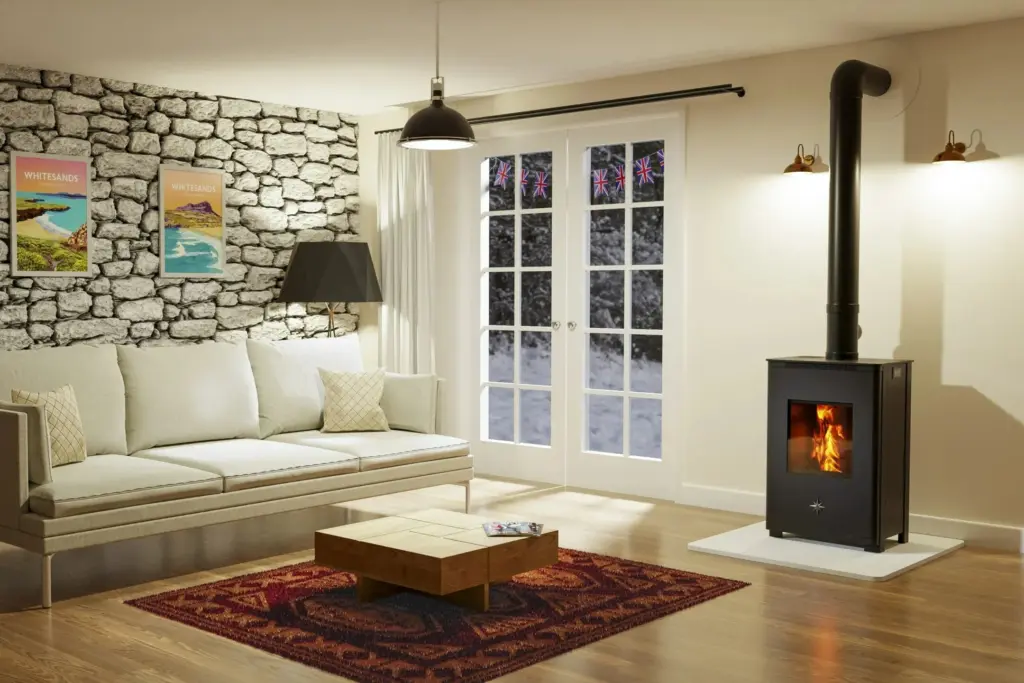
You can have a log burner without a chimney if your home has a safe route for a twin wall flue, and a balanced flue pellet stove is the alternative where a tall flue is impractical or unwanted. Choose the log burner to burn logs without relying on mains power, or the balanced flue stove for automatic heating and a short route through a wall.
At Island Pellet Stoves in Cardiff, we build and fit every stove ourselves, and our team specialises in fitting balanced flues. Standard production takes eight weeks, or up to 12 at peak times. We install stoves anywhere in the UK. You can see how our balanced flue works or call us on 0330 111 4747 to talk through your home.