

How to replace a back boiler wood burner stove with a modern pellet system
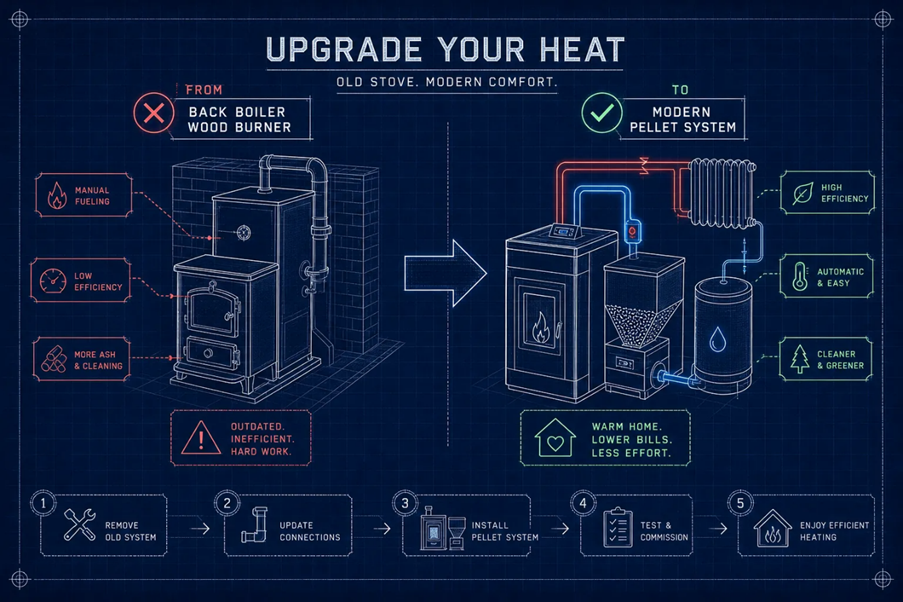
Back boiler wood burner stoves were, for their time, widely regarded as a pragmatic engineering compromise: one appliance producing room heat and feeding a wet radiator circuit from a single fire. Many are still running in British homes today, though the exact number is difficult to quantify. The homeowners operating them are dealing with a system that demands constant attention, delivers heat only when the fire happens to be burning, and increasingly struggles to meet current emissions standards. This article walks through how these systems actually work, where they fall short, and why a compact, HETAS-certified pellet boiler stove is now the cleaner, more practical replacement for whole-house heating from a standard British fireplace.
What a back boiler wood burner stove actually does
A wood burning boiler stove splits its output between radiant room heat and hot water fed into the wet central heating circuit. The heat-to-water ratio is not fixed. It depends on burn rate, flue draw, system design, and fuel moisture, which means real-world performance rarely matches the nameplate figure. At a realistic operating split, roughly 45% of the stove’s useful output goes to the room and 55% goes to the water circuit.
How the heat split works in practice
A back-boiler stove rated at 12 kW total delivers approximately 5.4 kW to the room and 6.6 kW to water at normal operating temperature. That water output is what matters for sizing against a radiator circuit: using the practical rule of 1 to 1.5 kW per standard radiator, 6.6 kW suits roughly five to seven radiators. A 20 kW unit delivering 14 kW to water might cover ten to twelve. Domestic hot-water draw reduces that number further, and any fuel with moisture above 20 to 25% will reduce actual output below the rated figure.
Why kW output figures mislead buyers
Many manufacturers headline the combined total output rather than the water output separately. A stove advertised at 12 kW is not delivering 12 kW to the radiator circuit, the buyer comparing models needs to locate the water kW figure specifically, not the total. This confusion between total kW and water kW is a common source of undersized installations, where the system cannot reach temperature in cold weather because the water output was never sufficient for the number of radiators connected.
Why back boiler wood burner stoves fall short
Running a woodburner with a back boiler in day-to-day life is quite different from reading a brochure about one. The problems are predictable, and they compound each other over time: inefficient and unpredictable heat delivery, a significant maintenance burden, and growing emissions compliance pressure.
Inefficient heat transfer and unpredictable output
A back-boiler stove cannot modulate on demand. It produces heat when the fire is burning at the right rate, and stops when it is not. Too slow a burn and the water circuit loses temperature before it reaches distant radiators. Too fast and safety overheating risks emerge. The result is heat on the fire’s schedule, not the household’s, a fundamental mismatch for any home treating the system as a primary heat source rather than an occasional supplement.
The maintenance load most people underestimate
A back boiler insert feeding a wet system requires manual fuel loading, daily ash clearance, at least annual chimney sweeping, and periodic inspection of the boiler section, circulating pump, and zone controls. When the stove is also feeding the radiator circuit, any single fault removes both room heating and central heating simultaneously. A seized pump, a corroded valve, or a blocked flue does not just take out one room: it takes out the whole system at once.
Emissions and EcoDesign compliance in 2026
Any new installation must use an EcoDesign-compliant appliance, a requirement in force since 1 January 2022 for room-heater stoves, including those with integral boilers. The EcoDesign particulate matter limit for wood-burning appliances is 40 mg/m³; for pellet appliances it is 20 mg/m³, reflecting the cleaner combustion profile of standardised low-moisture fuel. Older back boiler inserts in smoke-control areas face additional exposure under Clean Air Act rules. Even a compliant wood-burning appliance carries inherent particulate emissions that pellet combustion substantially reduces.
Why a pellet boiler-stove outperforms a back-boiler system
A pellet stove is an engineering upgrade over a manually fired back-boiler insert: automated fuel feed, consistent burn temperature, measurably lower emissions, and a sealed fuel system that eliminates smoke entering the room. Each of these properties addresses a specific failure mode of the older woodburner.
Automated operation versus manual fire-tending
A pellet stove runs on a timer. Fuel feeds automatically, ignition is automatic, and temperature is controlled precisely without anyone present. No one needs to be home to light it, reload it, or manage the draw. For a household using the stove as a primary heat source connected to a radiator circuit, this is the most important practical difference from any manually loaded wood burning boiler stove.
Consistent heat output for radiator circuits
Pellet stoves automate and control combustion, sending a steady, predictable stream of heat to your radiators. Forget the unpredictable spikes of a manual back-boiler stove—there’s no overshooting or freezing just because of how much wood you threw in half an hour ago. This reliable consistency protects your system, makes your thermostat actually work, and ensures distant radiators heat up exactly when you need them to.
Emissions: a measurably cleaner burn
Modern certified pellet stoves produce substantially fewer particulates than wood log appliances. Pellets are a standardised, low-moisture fuel, which removes the single largest source of poor combustion in traditional wood burning. A sealed fuel system means no smoke enters the room during operation. The EcoDesign particulate limit for pellet appliances is half that applied to wood-burning stoves, and many high-performing certified pellet models achieve significantly better than the 20 mg/m³ limit in standard tests.
How an 8 kW pellet boiler-stove replaces back boiler wood burner stoves in existing homes
Island Pellet Stoves manufactures a compact 8 kW unit built specifically for the UK market. The Lundy 8 back-boiler pellet stove is designed to connect to an existing wet radiator circuit in a standard British home. The unit was developed to address the pecific engineering challenges of fitting modern pellet technology into a standard British fireplace opening.
The output that covers a typical UK home
An 8 kW pellet unit supplying water to a radiator circuit can cover five to eight standard radiators, depending on insulation and radiator sizing, sufficient for a typical three-bedroom British semi-detached. Unlike a back-boiler stove where water output is always a fraction of the headline rating, a pellet unit designed for radiator connection allocates output cleanly and consistently. At 3 to 5 kW average modulated output, the stove consumes approximately 0.7 to 1.3 kg of pellets per hour, with a full heating season typically requiring 1.5 to 3 tonnes of pellets.
Why compact dimensions matter for a British fireplace
Island Pellet Stoves designs its units with the constraints of a standard UK fireplace opening in mind. The top-mounted flue is intended to connect to an existing chimney liner, and the stove is sized to occupy a similar footprint to a typical back boiler insert. That said, every installation requires a site survey to confirm whether the existing chimney liner is suitable, whether hearth sizing meets Approved Document J requirements, and whether any structural works are needed. A registered HETAS installer will carry out this assessment before any work begins.
Combustion design and room heat delivery
The Island Pellet Stoves unit is designed to distribute room heat efficiently whilst the combustion system produces a natural, flickering flame that replicates a traditional log burner visually. For anyone replacing a back-boiler insert, the transition can feel seamless in appearance whilst delivering a meaningful improvement in operational performance. Specific acoustic and electrical consumption figures vary by model and should be confirmed with the Island Pellet Stoves technical team at survey stage.
A Cardiff retrofit: replacing a back boiler insert with a compact pellet unit
In one illustrative retrofit, a homeowner in a standard mid-terrace property in Cardiff was running a back boiler insert feeding six radiators. The system required regular chimney sweeping, daily ash management, and periodic attention to the pump and controls. The boiler section had begun to corrode, a common failure point in older back-boiler installations where return-water temperatures fall too low. Island Pellet Stoves were engaged to assess and carry out the replacement.
What the retrofit involved
The old back boiler insert was removed. The existing chimney was assessed and lined. The Island Pellet Stoves 8 kW unit was fitted into the same opening using the top-mounted flue connection and plumbed directly into the existing radiator circuit. The chimney lining work was completed as part of the installation, and no structural alteration to the fireplace surround was required in this instance. The opening that previously housed a manually fed, smoke-producing back-boiler system now held an automated, HETAS-certified pellet stove.
The all-in package: what is included from day one
Island Pellet Stoves’ all-in packages from £4,950 cover the stove unit, all flue pipework, professional installation by a registered engineer, HETAS certification, and a personal customer training session. (Pricing is indicative and subject to site-specific requirements, a survey will confirm the final figure.) The homeowner receives a commissioned, certified system, not a stove delivered in a box with a manual and a list of trades to call. A HETAS-registered installer can self-certify the work and notify Building Control in England and Wales, satisfying Building Regulations requirements without a separate application, though the installer must be registered for the correct appliance category, and the scope of notification should be confirmed at survey stage.
What the homeowner gained
Automated heating on a timer. No daily ash clearance between pellet fills. Substantially lower particulate emissions than the previous wood burning system, moving from the 40 mg/m³ wood-burning threshold to the 20 mg/m³ pellet standard. A similar flame aesthetic in the same fireplace opening, without any of the maintenance burden that came with the back-boiler insert. The homeowner reported running costs for the heating season in the £800 to £1,200 range, covering pellet fuel, electricity for controls, and routine servicing, with no emergency callouts during the follow-up period documented by the installer.
Regulations, certification, and what a proper installation covers
UK homeowners replacing a back boiler wood burner stove with a pellet unit need clarity on three things: what HETAS certification actually confirms, what Building Regulations require, and what a complete compliant installation includes. Getting these right protects the homeowner legally and ensures the system operates safely.
HETAS certification and Building Regulations
In England and Wales, any new solid-fuel or biomass appliance installation must be notified to Building Control. A HETAS-registered installer can self-certify the work, removing the need for a separate Building Control application. The installation must comply with Approved Document J: hearth sizing, appliance clearances, flue construction and lining, ventilation provision, combustion air, and a permanently installed carbon monoxide alarm in the same room. HETAS certification confirms the complete installation, not just that the stove fits the opening.
EcoDesign compliance for pellet appliances
All pellet stoves placed on the UK market since January 2022 must meet EcoDesign emissions and efficiency minimums: a seasonal efficiency of at least 79% and a particulate matter limit of 20 mg/m³. Island Pellet Stoves’ units are designed to meet these requirements from the outset. Purchasers should verify the specific model’s test documentation and confirm EcoDesign compliance with the manufacturer prior to installation, independent verification of lab test data is always advisable.
What a complete installation should always include
The stove unit itself is only part of what a homeowner needs. A complete installation covers the stove, flue pipes matched to the chimney, professional fitting by a registered engineer, HETAS certification issued on completion, and a training session covering timer control, pellet loading intervals, and routine care. Anything short of this combination is not a complete system: it is a stove that may or may not be legal, safe, or covered by Building Regulations compliance.
FAQ: Replacing back boiler wood burner stoves with a pellet system
Can a pellet stove connect to an existing radiator circuit?
Yes. A pellet stove with a water-to-radiator output can plumb directly into an existing wet central heating circuit, provided the circuit is correctly sized and the stove’s water kW output matches the radiator load. A site survey will confirm compatibility.
Do I need planning permission to replace a back boiler insert?
In most cases, no. Replacing a like-for-like appliance in an existing fireplace typically does not require planning permission. However, the installation must be notified to Building Control, which a HETAS-registered installer can handle through self-certification. Listed buildings and conservation areas may have additional requirements.
How long does the installation take?
A straightforward retrofit, removing the old back boiler insert, lining the chimney, and fitting the pellet stove, typically takes one to two days, depending on chimney condition and circuit complexity. A pre-installation survey will give a more accurate estimate for your specific property.
What ongoing maintenance does a pellet stove require?
Routine maintenance includes emptying the ash drawer periodically (far less frequent than daily wood-burner ash clearance), refilling the pellet hopper, and an annual service by a registered engineer. The chimney or flue should be inspected annually. There is no manual fuel loading, no daily fire-lighting, and no pump or boiler section to monitor independently.
Back-boiler wood burner stoves served a purpose, but the combination of manual operation, significant maintenance demands, emissions compliance pressure, and fundamentally unpredictable heat output makes them difficult to justify as a modern whole-house heating solution. A compact, HETAS-certified pellet stove delivers what the back boiler always promised: room heat and radiator heat from a single appliance in a standard British fireplace, with automated control, consistent output, and far cleaner combustion. The Cardiff retrofit illustrates what this looks like in a real British home. To assess your fireplace opening, radiator circuit, and applicable package options, contact the Island Pellet Stoves team for a site survey.